Walking and Working Surfaces
As noted earlier, many engineered solutions exist to solve the problem of workplace STFs and plug the profit leaks associated with STF costs. A study conducted by the National Floor Safety Institute, NSFI, found a dozen or so major factors contributing to STF events. Things like illumination, signage, types of footwear, maintenance, surface contaminants, and others all contribute to a slip or trip. What this study found was that over half, 55%, of all STF events were directly related to the walkway or working surface. Thought of in another way, that is 110,000 of the 200,000 STF recordables each year are designed to happen from the start. Choosing the right types of walking and working surfaces is critical to having a safe and productive working environment.
A slip event takes place when the required friction of a step, FR, exceeds the available friction of the walking surface, FA. The required friction, FR, will differ with each person and even with each step. Many things determine what this required friction amount is. The type of footwear worn, a person’s age, weight, gait, and physical condition all go into determining the FR value for a step. Studies found that for every decade a person ages, both the frequency of and severity of resulting injuries increase in slip and fall. With an aging workforce, this makes the need for higher safety imperative.
All materials have an inherent available friction value, FA. The condition of that surface, whether dry or contaminated with water or oil for example, will greatly affect the surface friction available (FA) and may drastically alter the slip and fall risks. For example, outdoor walkways need to have sufficient friction in rainy conditions and not simply dry ones to insure slip-free passage since they are often subject this type of environment. Work platforms exposed to oil or lubricants must provide adequate surface friction even if submerged in these slippery fluids to provide safe steps for the workers operating on them. The key to designing a safe and productive walking/working surface is choosing the correct material which provides the maximum amount of surface friction available for conditions they may conceivably experience.
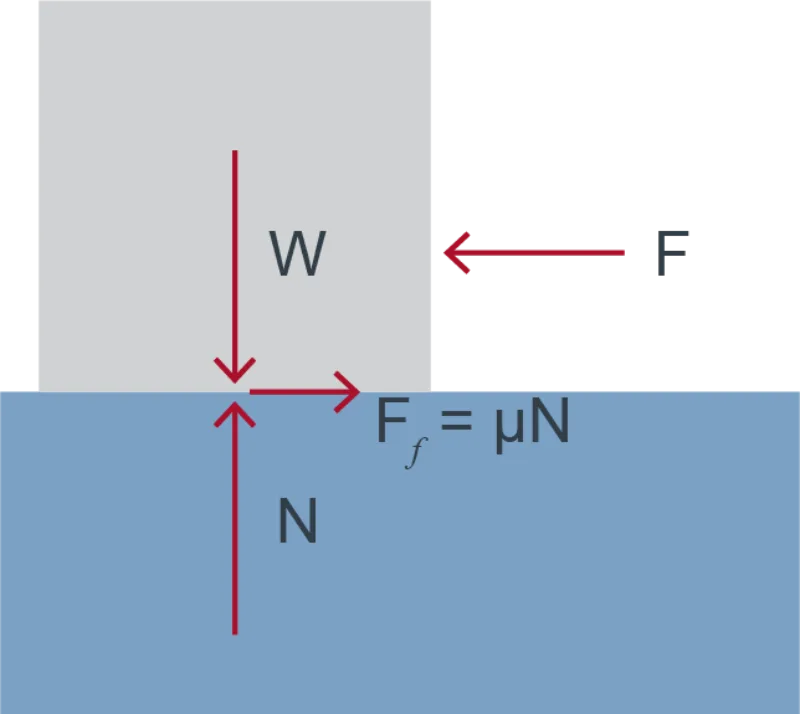
Since available surface friction decreases with wear, monitoring these surfaces is the other critical step in maintaining maximum safety and elimination of STF events. The measurement unit used in determining safe versus unsafe walking surfaces is most often the coefficient of friction (COF) value of the material’s surface. The coefficient of friction of a surface is calculated from determining the force required to move an object at rest divided by the mass of the object. If you have a ten kilogram weight that requires five kilograms to start this weight into motion, dividing 5 by 10 give a COF value of 0.5. Since the starting weight is at rest in this measurement, this is known as the static coefficient of friction or SCOF.
Since by definition walking is not a static process, many contend that measuring dynamic coefficient of friction, or DCOF, is a better way to determine a walkway or working surface safety. DCOF is also a ratio of forces but in this case it is taking the resistive force exerted on a weight in motion divided by that weight. As in example above, if a 10 kilogram moving weight experiences 5 kilograms of resisting force, it is determined to have a DCOF value of 0.5. There are other ways of comparing the safety of different surfaces but SCOF an DCOF are the most widely used within the United States, which we will concentrate on in this paper.
Devices called tribometers measure SCOF and DCOF values. This equipment is used both in laboratory and field settings. Over the years, the quality of and the repeatability of results generated by modern tribometers has greatly increased. The ease of use of many types of these units has also significantly increased over this period. Monitoring floor safety with these units can be contracted to specialist companies providing these services or now can be easily included as part of a company’s maintenance program with minimal staff training. Tribometers are a critical part of a successful floor safety monitoring program to maximize employee safety. With the high costs of STF events, these monitoring programs more than pay for themselves in short order.

 Article